

Electro-
deionization
(EDI)

Eco-Friendly Water Treatment
Specialty Equipment
Water treatment Specialty,
Chemicals & Equipment

TRILITE® has newly launched EDI (Electrodeionizer), an eco-friendly water treatment system that combines electricity, ion exchange membranes, and ion exchange resins to remove ionic impurities from water and continuously produce high-purity
pure and ultrapure water.
Together with ion exchange resins and RO, Samyang provides total solutions to the global water treatment market.
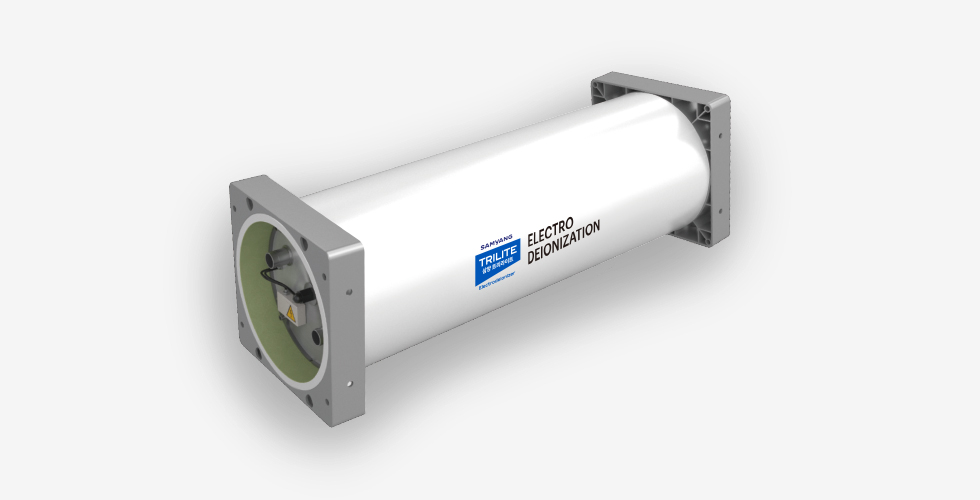
In 2022, TRILITE® entered the EDI market by signing an MOU with GEUMHWA WTS Co., Ltd. (formerly, Ecorbit Engineering Co., Ltd.) and is targeting the global premium water treatment market, such as ultrapure water and power plants, by utilizing Samyang's overseas network.
  • ion exchange resin
  • RO
  • Electrodeionizer

EDI Application

Produces ultrapure and pure water
for nuclear/thermal power plants, semiconductors, and other
industrial plants.

EDI Advantages

  • An eco-friendly facility with continuous production and no regeneration process

    EDI is an eco-friendly facility that does not discharge wastewater from regeneration chemicals and can ensure stable water quality through continuous operation without

  • Production of demi and ultrapure water by module

    It has a design structure that makes it easy to expand the processing capacity (5~18㎥/hr) and simple to replace and maintain, making it suitable for use in various fields such as in power plants, electronics, semiconductors, pharmaceuticals, and food.

FAQ

  • Q. What is EDI (electrodeionization), and how does it differ from conventional ion exchange resin systems?

    EDI is water treatment equipment that combines ion exchange membranes, ion exchange resins, and direct current electricity to remove ionic impurities from water and continuously produce high-purity pure and ultrapure water. Auxiliary equipment such as conventional dosing pumps and neutralization tanks is eliminated, which also reduces the installation footprint.

    In ion exchange resin systems, once the resin is saturated it must be chemically regenerated with acid and alkali, and production must stop in the meantime. EDI, by contrast, operates in CEDI mode, continuously regenerating the ion exchange resin using direct current, so there is no separate chemical regeneration process or resulting downtime.

    Because no regenerant chemicals such as strong acids and alkalis are used, the risks of safety incidents and equipment corrosion are reduced, and auxiliary equipment such as chemical storage tanks, dosing pumps, and neutralization tanks is unnecessary, reducing the installation footprint.

  • Q. Why is Samyang's TRILITE® EDI an eco-friendly system?

  • Q. How do the TU series and TN series of Samyang's TRILITE® EDI differ?

Inquiry AI Chatbot
TRILITE AI AGENT,
Inquiry TRIGENT!
Catalog History
Museum
TriAngle
(IER)
TriAngle
(RO)
Inquiry
Maximize Minimize
TOP

We refuse unauthorized email collection

Close

We refuse the unauthorized collection of the email addresses on this website using email collection programs or other technical devices. Please note that any violation will be subject to criminal penalties in accordance with the Act on Information and Communications Network.

Posted on March 28, 2023

Cookie Popup Close
Manage Cookies

This site uses cookies.
By continuing to browse the site,
you agree to the use of cookies.

Privacy Policy Accept